
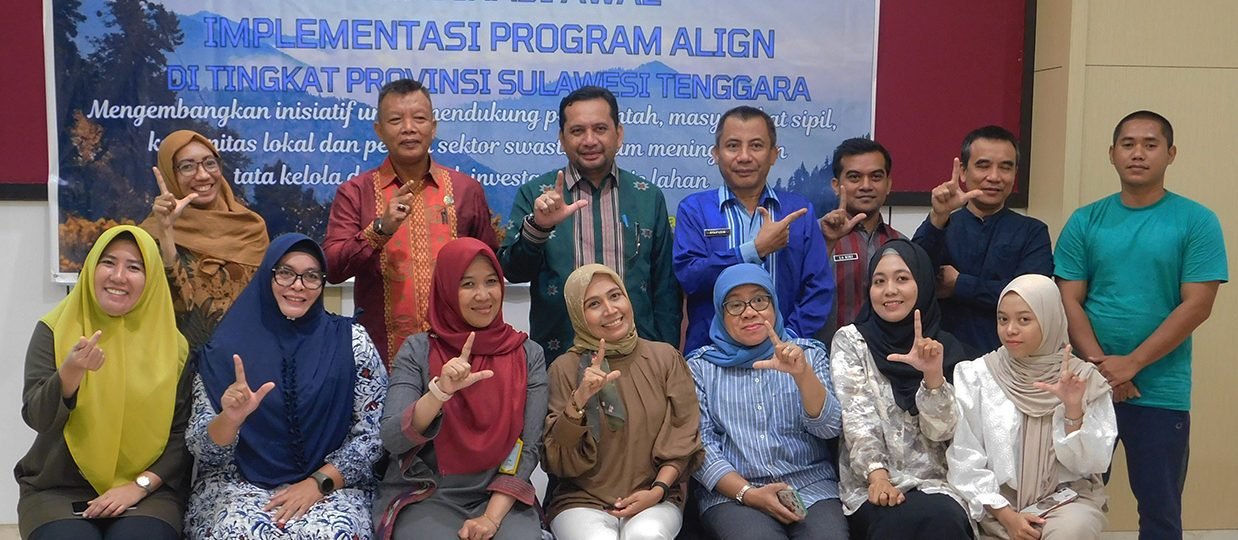
The initial coordination meeting at the provincial level in Southeast Sulawesi marked the first step in the implementation of the ALIGN (Advancing Land-Based Investment Governance) program by Komunitas Teras. The purpose of this activity was not only to introduce the program and secure support for its implementation, but also to foster a shared understanding among provincial government stakeholders on advancing fair and sustainable oil palm plantation governance and ensuring that land-based investments contribute positively to the environment, communities, and the economy. This shared understanding is essential given the complex dynamics of natural resource management, making cross-sectoral collaboration a key factor in achieving sustainable solutions. The initial coordination meeting for the ALIGN program at the provincial level was held in Kendari on April 25, 2024, and attended by relevant agencies, including the Southeast Sulawesi Provincial Development Planning Agency (Bappeda), the Department of Plantation and Horticulture, the Environmental Agency, the Forestry Department, the Department of Food Crops, and the Department of Transmigration. The meeting also brought together civil society organizations involved in the ALIGN program in Southeast Sulawesi, including WALHI Sultra, Puspaham, Komdes, and Rumpun Perempuan Sultra.
During the meeting, the Southeast Sulawesi Provincial Department of Plantation and Horticulture and the Southeast Sulawesi Provincial Forestry Department shared data and information on policies governing the oil palm plantation sector and efforts to resolve conflicts related to the use of forest areas. Other relevant agencies also shared information within their respective areas of authority concerning these two sectors. The discussions highlighted the complex challenges of cross-sectoral governance in maintaining a balance between environmental sustainability and economic development, particularly in the context of oil palm plantations in North Konawe Regency. Oil palm is currently one of the renewable energy sources used in biodiesel production; however, it also poses serious environmental impacts, including increased emissions and land expansion encroaching into forest areas. The meeting identified several issues requiring joint follow-up by the relevant agencies to promote equitable and sustainable land-based natural resource management. First, there is a need to integrate data across the oil palm plantation sector to address problems caused by data that are unavailable, incomplete, inaccurate, or inconsistent among relevant agencies. Second, policy integration is needed to align regional-level policies, including law enforcement and oil palm plantation governance. Consistent law enforcement is essential to ensure compliance with existing regulations. Third, stronger coordination is crucial to promoting fair and sustainable oil palm plantation governance. Current oil palm plantation practices have also contributed to conflicts that can only be resolved through intensive coordination among the government, communities, private sector, civil society organizations, and other relevant stakeholders. Through the ALIGN program’s interventions, positive change is expected to be achieved, contributing to efforts to establish fair and sustainable land-based natural resource governance in Southeast Sulawesi Province.