

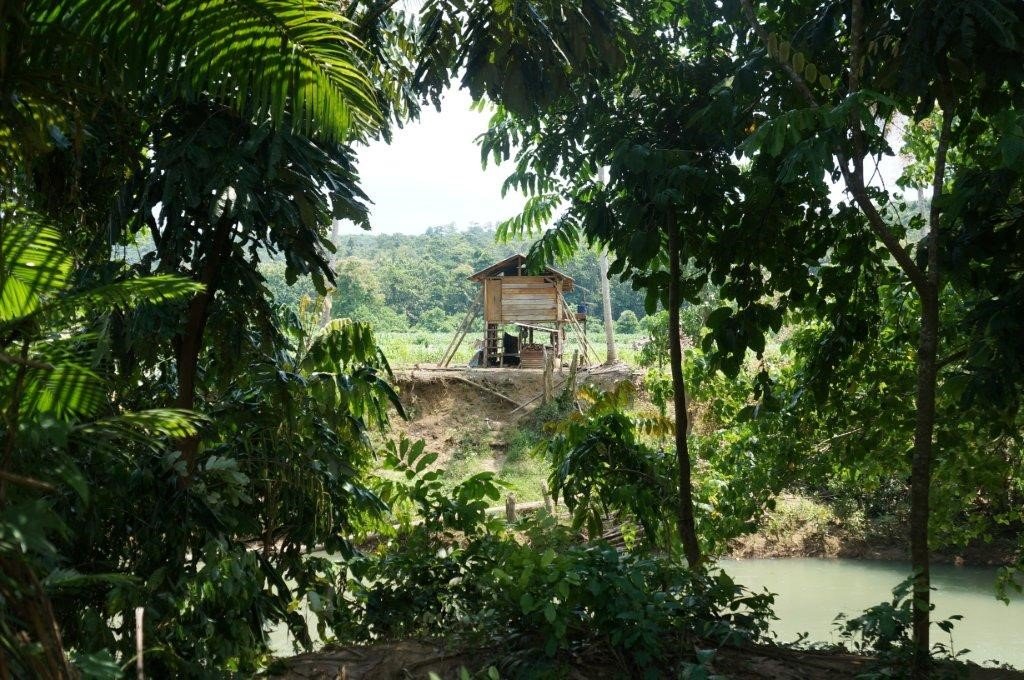
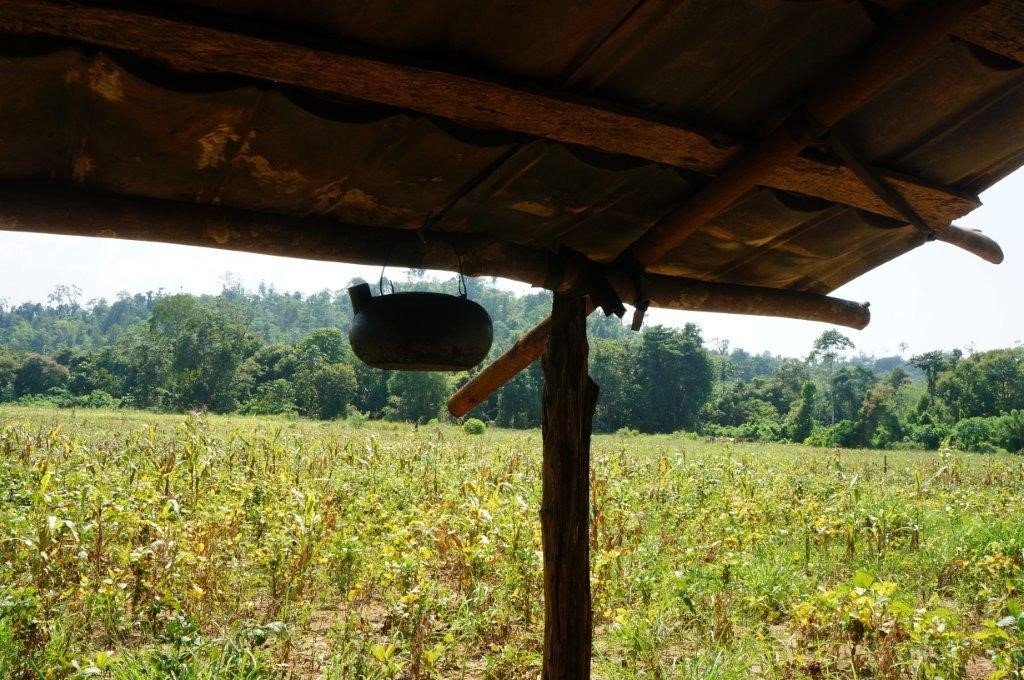
Legume Crop Field (Soybeans) Owned by a Resident of Tambakua Village, Landawe District, North Konawe Regency (Documentation: Teras, 2021)
Paro, a father of seven, is a dryland farmer from Asera District who has been cultivating fields around the Lasolo–Lalindu Watershed for more than 50 years. With more than 10 grandchildren, he relies on several agricultural plots that have been cleared and cultivated across generations to support his family. Dryland plots in Oheo, Wiwirano, Polopolora, and Polora Indah, first opened in the 1970s, are used to grow upland rice, secondary crops, and vegetables. In the past, the farming areas around the Landawe–Lalindu river system were part of Asera District. The forest areas cleared for cultivation at each location generally covered one to two hectares. To this day, Paro, his children, and his extended family continue to manage these fields using traditional and sustainable practices as a source of food for the household. Farming is commonly practiced through shifting cultivation. This practice is widespread in Indonesia and in many other parts of the world, particularly in tropical regions. In Indonesia, terms for cultivated fields vary by region: tegal in East and Central Java, huma in West Java, juma in Sumatra, umai in Kalimantan, and teponda’u/anahoma among the Tolaki people of Southeast Sulawesi. For local communities in North Konawe, shifting cultivation is a traditional agricultural activity on which many residents depend for their livelihoods. Teponda’u refers to the sustainable cultivation of food crops on farming plots in the Lalindu–Lasolo Watershed. It is a local agrarian tradition practiced using simple tools and encompasses land preparation, planting, crop maintenance, harvesting, and storing produce in granaries. Local dryland farmers carry out teponda’u based on local knowledge, aligning their farming practices with the sustainability of livelihoods and the balance of nature. Local wisdom is an important aspect of traditional agricultural systems. It is often understood as place-based knowledge that incorporates various strategies for addressing challenges related to the environment, food security, and community adaptation to changes in the natural and social environment. Some Tolaki and Culambacu communities living and farming around the Lasolo–Lalindu Watershed continue to maintain shifting cultivation as part of their agricultural culture. This long-standing tradition has been passed down through generations among agrarian communities. Shifting cultivation is guided by values and norms that emphasize the sustainability of livelihoods and ecological balance. Kardin, a farmer from Polora Indah Village, grows upland rice and vegetables for household consumption, while some secondary crops are sold at the market to generate family income. Dryland farming is carried out through samaturu, a tradition of mutual cooperation involving spouses, children, extended family, and relatives. Land preparation can take between one week and four months and is conducted collectively through cutting trees, clearing grass, burning wood and shrubs, and removing the remaining grass after burning. Planting is also undertaken collectively. Farmers use a dibble stick to make holes in the soil and place rice seeds into them. Weeds are cleared approximately one month after planting by spraying, cutting, and pulling them out. Pest and disease management is still partly carried out through traditional prayer rituals known as monggawui. When crops are attacked by rats, no specific treatment is applied. Birds and monkeys are deterred by guarding the crops, while caterpillars and grasshoppers are controlled using pesticides. Upland rice is harvested when the plants are more than four months old. Through generations, farmers have learned their agricultural practices from their ancestors. Although farmers consider growing upland rice and other food crops relatively straightforward, crop failures still occur frequently, particularly when crops are affected by pests, diseases, or hydrometeorological disasters. Farming upland rice and other food crops on teponda’u dryland depends heavily on rainfall as the primary source of water during the early stages of plant growth. Consequently, upland rice is cultivated only once a year. Rice planted in December or January is usually harvested around May or June. Dryland plots used for upland rice cultivation are generally cultivated for only two to three growing seasons. Afterward, farmers leave the land fallow to recover and either open new plots or cultivate other fields that have completed their fallow period. Abandoned plots are generally brought back into cultivation after two to three years. Traditionally, the Tolaki people recognize thirteen stages in the teponda’u process. These are: 1) observing and selecting land for cultivation (monggiki’i ando’olo); 2) conducting the teponda’u ritual to seek success in farming (mohoto’o wuta); 3) clearing shrubs and small trees and removing stumps and roots (mosalei); 4) cutting and removing large trees (mombodoi/monduehi); 5) burning unused cut vegetation (humunu); 6) clearing the remaining debris after burning (mo’enggai); 7) fencing the plot using felled timber (mewala); 8) planting rice seeds (motasu), secondary crops, and vegetables; 9) removing weeds and caring for crops (mosaira and mete’ia); 10) harvesting agricultural produce (mosawi); 11) storing the harvest in a granary (molonggo); 12) allowing the field to rest after two to three growing seasons; and finally, 13) before leaving an unproductive field, restoring vegetation by planting timber and other perennial trees to mark the land (anahoma).
Legume Crop Field (Soybeans) Owned by a Resident of Tambakua Village, Landawe District, North Konawe Regency (Documentation: Teras, 2021)
An examination of the thirteen stages of *teponda’u* practiced by farmers reveals several activities that serve as disaster mitigation measures, particularly against forest fires, erosion, landslides, and floods. Local wisdom embedded in farming traditions contributes to disaster risk reduction and environmental sustainability through practices such as selecting cultivation sites (*monggiki’i ando’olo*), controlled field burning (*humunu*), and replanting former fields (*anahoma*) that have become less productive. Site selection is associated with landslide mitigation, while field-burning practices are related to forest fire prevention. Replanting old fields with timber or other long-term crops is closely linked to livelihood sustainability and ecosystem balance. According to Jamaluddin et al. (2019), local wisdom related to disaster mitigation and environmental sustainability includes the following practices:
- Selection of Farming Sites (*Monggiki’i Ando’olo*)
The first step in *teponda’u* is selecting the land to be cultivated as a field. One of the ideal criteria is relatively flat terrain. This not only makes the land easier to access and cultivate but also helps prevent erosion and landslides. Another consideration is soil fertility, which reduces the need for fertilizers, especially synthetic fertilizers containing chemical substances. Fertile soil also allows crops to be cultivated without plowing, helping maintain soil stability.
- Field Burning (*Humunu*)
Field burning is carried out to clear trunks, branches, and woody debris left over from clearing vegetation (*mosalei*) and cutting trees (*mombodoi/monduehi*). Before burning, farmers carry out *mekere* by creating a firebreak in the form of a circular boundary designed to prevent the fire from spreading beyond the area intended for cultivation. The firebreak is approximately three to four meters wide. In addition to providing access for monitoring the burning process, it helps prevent fire from spreading to other fields or areas. To facilitate burning, the vegetation cleared during mosalei, mombodoi, and mekere is left to dry for one month or longer. Farmers draw on their practical knowledge and experience to determine where to start the fire. One important consideration is the direction of the wind at the time of burning. The effectiveness of the burning process depends greatly on accurately selecting the ignition point. Burning is carried out simultaneously in the late afternoon, with all farmers participating. They work together to monitor the fire until the process is completely finished. The final stage involves inspecting the area and collecting trees and branches that have not burned completely (mo’enggai), so they can be burned again later before planting begins. The field-burning process demonstrates collective planning among farmers. It also involves organizing activities and dividing participants into groups to ensure effective fire control. For generations, farming communities have practiced controlled field burning without causing large-scale forest fires.
- Revegetating Old, Unproductive Fields with Long-Term Crops (*Anahoma*)
When soil fertility declines after repeated cultivation, farmers leave the field and move to a new location or return to an older field that has been left fallow. Before leaving an old field, known as *anahoma*, they plant perennial trees such as teak, durian, coconut, and other timber species as markers of ownership. Areas of anahoma that develop into secondary forest after being abandoned are generally former cultivation sites belonging to farmers from the same extended family. Under Tolaki customary law, the land may be cultivated again by the original farmers or their descendants after nine years of being left fallow. The concept of anahoma serves not only to identify land ownership but also to allow cleared forest areas to regenerate. Within the shifting cultivation practices of the Tolaki Indigenous community, anahoma has multiple functions: establishing ownership, restoring soil fertility for future cultivation, and helping maintain forest functions and ecological balance throughout the Lasolo–Lalindu Watershed.