
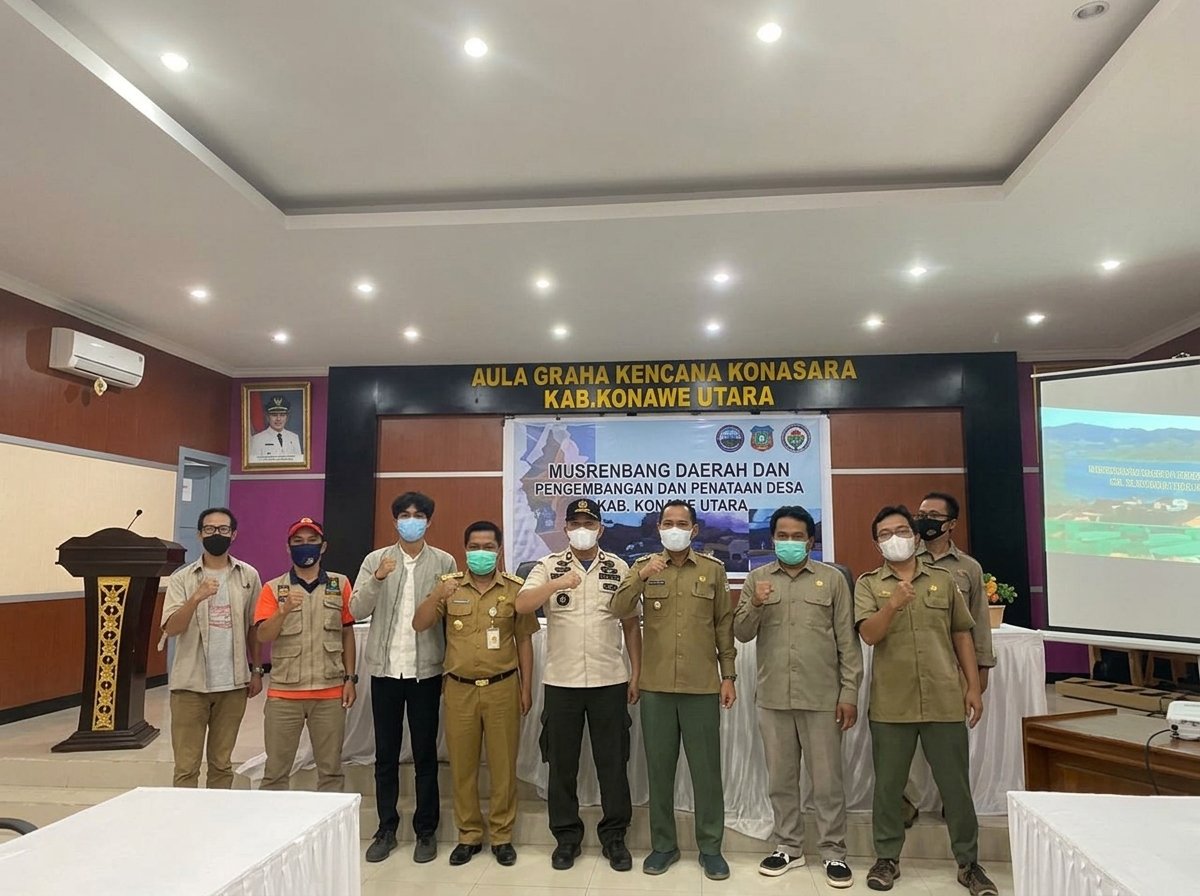
By the Komunitas Teras Team. Floods are a consequence of watershed conditions, and the extent of the destructive impacts they cause, both socially and ecologically, reflects the condition of the watershed itself. Inputs within the watershed, including government policies on governance and community activities that are part of long-established cultural practices, shape the social, economic, and political dynamics of the Lasolo Watershed ecosystem. Because watershed boundaries do not follow administrative boundaries, many parties have interests in various matters within their respective areas of responsibility. Regardless of the spatial management policies implemented by different parties, communities have lived and interacted within the Lasolo Watershed long before the state assigned its mandates. Another fact is that climate change is no longer merely an issue; its impacts are already evident in the hydrometeorological disasters occurring across the Lasolo Watershed as a result of extreme rainfall. Over the past five years, the Lasolo River has experienced recurring floods with varying levels of impact. Synergy among programs for managing the Lasolo Watershed is key to addressing climate-related disasters and building resilience against these threats. Integrated planning by stakeholders, together with the participation of communities living around the Lasolo Watershed, is essential to strengthening disaster resilience and the capacity to adapt to climate change. This workshop was part of an effort to build cross-sectoral synergy in planning for the Lasolo Watershed. The workshop was held on February 9, 2021, at the Hall of the North Konawe Regency Office of the National Population and Family Planning Board (BKKBN). The objectives of the workshop were to establish a shared understanding of the various issues affecting the Lasolo Watershed within the framework of climate change adaptation and disaster risk reduction; develop synergies for integrated Lasolo Watershed management; and establish a framework for cooperation and strategies for sharing roles in watershed management. The workshop was attended by the Regent of North Konawe, the Head of the North Konawe Regional Development Planning Agency (BAPPEDA), the North Konawe Community and Village Empowerment Office (BPMDes), the North Konawe Regional Disaster Management Agency (BPBD), the Sampara Watershed Management and Forest Protection Agency (BPDAS HL), the Chair of the Southeast Sulawesi Watershed Forum, the Region IV Kendari River Basin Office (BWS), the Lasolo–Konaweha Integrated Water Resources Management Coordination Team (TKPSDA), civil society organizations (CSOs), and representatives of communities around the Lasolo Watershed. The Regent actively participated in discussions on mapping roles and developing strategies for sharing responsibilities in managing the Lasolo Watershed to improve climate change adaptation and reduce disaster risks. As a result, several strategic points were agreed upon during the workshop.